2024 HSC Mathematics Extension 1
Question 2:
Definite integral
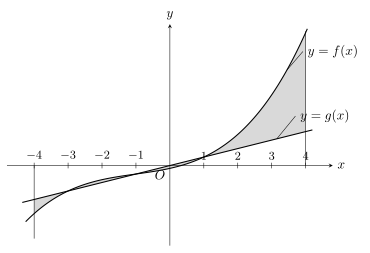
Consider the functions and , and the regions shaded in the diagram (accessible description: the curves intersect at on ; shaded bands occupy , , and between the curves).
Which of the following gives the total area of the shaded regions?
How to recognise this question
Question type: definite integrals areas
- The command and notation point to definite integrals areas.
- The requested response is a multiple choice.
How to handle it: find a suitable antiderivative, substitute the upper and lower bounds, and subtract in that order.
Watch out: Do not select a formula until its domain, interval, sign and units match the question.
Step-by-step answer
- Total area is the sum of absolute contributions , not the net signed integral over the whole interval.
- Option A is a single signed integral and can cancel positive against negative regions.
- Option B takes the absolute value of the net integral, which still allows internal cancellation before the absolute value is applied.
- Option C uses the same signed difference on every subinterval, so it equals A and fails wherever .
- Option D reverses the sign on intervals where lies above (namely and ) and keeps the positive orientation where is above . That is equivalent to integrating piece by piece.
- Answer: D. (NESA multiple-choice key: D.)
Common mistake: choosing a familiar formula before checking that its conditions, signs, interval and units match this question.
The paper records 1 total mark for this group. Where the official marking guide provides useful partial-credit criteria, those criteria are stated in the steps above.
Try your hand at it again by answering these questions
Question 1
Curves meet at and on , with on and on . The total shaded area between them is
Question 2
On , changes sign at . Which expression always equals the total area between the graphs?
Question 3
If but on a set of positive measure, the total area between the curves is