2023 HSC Mathematics Extension 1
Question 9:
Inverse function
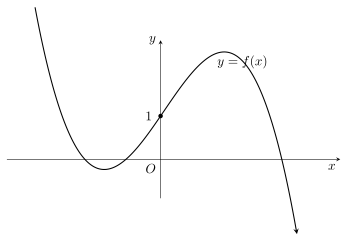
The graph of a cubic function, , is given (cubic with a local minimum left of the origin below the -axis, a local maximum to the right of the origin above , crossing the positive -axis at height ).
Which of the following functions has an inverse relation whose graph has more than points with an -coordinate of ?
How to recognise this question
Question type: inverse functions
- The command and notation point to inverse functions.
- The requested response is a multiple choice.
How to handle it: replace the function value by y, swap x and y, then solve for y.
Watch out: Do not select a formula until its domain, interval, sign and units match the question.
Step-by-step answer
- The inverse relation of is . Points on the inverse with -coordinate correspond to solutions of , i.e. intersections of with the horizontal line of height , then swapping coordinates.
- Equivalently: count how many points on have -coordinate ; that is the number of inverse points with .
- For , negative lobes of the cubic are reflected above the -axis. The line then meets both the original upper arc and the reflected lower arcs, producing more than three intersections.
- For , the cubic line meets the graph in at most three points. Reciprocal and even-extension versions do not produce more than three level- points in the required way.
- Answer: D. (NESA multiple-choice key: D.)
Common mistake: choosing a familiar formula before checking that its conditions, signs, interval and units match this question.
The paper records 1 total mark for this group. Where the official marking guide provides useful partial-credit criteria, those criteria are stated in the steps above.
Try your hand at it again by answering these questions
Question 1
How many real solutions does have?
Question 2
Starting from a cubic that dips below , the transformation most likely to create extra intersections with is
Question 3
If a graph meets the line at exactly five points, the inverse relation meets at