2023 HSC Mathematics Extension 1
Question 14(b):
Polynomial roots
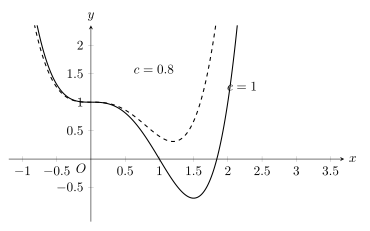
Consider the hyperbola and the circle , where is a constant.
(i) Show that the -coordinates of any points of intersection are zeros of .
(ii) By considering the given graphs of for and , or otherwise, find the exact value of such that the hyperbola and circle intersect at only one point.
How to recognise this question
Question type: polynomial roots
- The command and notation point to polynomial roots.
- The word “hence” means the later part is intended to reuse the earlier result.
How to handle it: translate the requested symmetric expression into sums and products of roots from the coefficients.
Watch out: Do not restart the second part with unrelated numbers or discard the result proved in the first part.
Step-by-step answer
- (i) Substitute into the circle: .
- Multiply through by : .
- Expand: .
- NESA (i): 1 mark.
- (ii) Single intersection (with ) corresponds to a repeated root of : solve and simultaneously.
- or .
- , so the double-root candidate is .
- : .
- .
- (since ).
- NESA (ii): 3 marks; 2 for -coordinate of double root in terms of ; 1 for recognising double-root / tangency condition.
Common mistake: choosing a familiar formula before checking that its conditions, signs, interval and units match this question.
The paper records 4 total marks for this group. Where the official marking guide provides useful partial-credit criteria, those criteria are stated in the steps above.
Try your hand at it again by answering these questions
Question 1
Consider the hyperbola and the circle , where is a positive constant.
(i) Show that the -coordinates of any points of intersection are zeros of .
(ii) Hence, by solving , find the exact value of such that the hyperbola and circle intersect at only one point.
Question 2
Consider and with .
(i) Show that intersection -coordinates are zeros of .
(ii) Hence find the exact for which there is only one intersection point.
Question 3
Consider and , .
(i) Show that intersection -coordinates satisfy .
(ii) Hence, by imposing a repeated root of , find the exact value of for a single intersection point.