2023 HSC Mathematics Extension 1
Question 13(b):
Vector motion
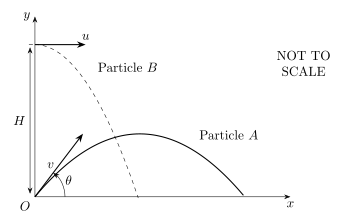
Particle A is projected from the origin with speed at angle to the horizontal. At the same time particle B is projected horizontally with speed from height above the origin.
Position vectors (Do NOT prove): , .
Given and the particles collide:
(i) By first showing , verify that .
(ii) Show that the particles collide at time .
(iii) When they collide their velocity vectors are perpendicular. Show that .
(iv) Prior to collision, the trajectory of A is a parabola. Find the height of the vertex of that parabola above the horizontal plane, in terms of .
How to recognise this question
Question type: vector motion
- The command and notation point to vector motion.
- The word “hence” means the later part is intended to reuse the earlier result.
How to handle it: differentiate position to get velocity and acceleration, then translate the angle condition into a dot product.
Watch out: Do not restart the second part with unrelated numbers or discard the result proved in the first part.
Step-by-step answer
- (i) Collision equates -coordinates: (for ).
- With in first quadrant: opposite , adjacent , hypotenuse , so , .
- Thus .
- NESA (i): 2 marks; 1 for equating -coordinates.
- (ii) Equate -coordinates at collision time : .
- Substitute and : .
- NESA (ii): 1 mark.
- (iii) Velocities: , .
- Perpendicular at : .
- Use , : .
- With : .
- NESA (iii): 3 marks; 2 for evaluating the dot product set to ; 1 for observing perpendicularity means dot product zero.
- (iv) For particle A, . Vertex when : .
- Height: .
- NESA (iv): 2 marks; 1 for setting vertical velocity of A to zero.
Common mistake: choosing a familiar formula before checking that its conditions, signs, interval and units match this question.
The paper records 8 total marks for this group. Where the official marking guide provides useful partial-credit criteria, those criteria are stated in the steps above.
Try your hand at it again by answering these questions
Question 1
Particle A is projected from the origin with speed at angle to the horizontal. Particle B is projected horizontally with speed from height above the origin at the same instant. Position vectors: , . Given and the particles collide:
(i) By first showing , verify that .
(ii) Hence show that the particles collide at time .
(iii) When they collide their velocity vectors are perpendicular. Show that .
(iv) Hence find the maximum height of A's parabolic trajectory prior to collision, in terms of .
Question 2
Same projection setup as the exam (A from origin at angle , B horizontal from height with speed ). Given and the particles collide:
(i) By first showing , verify that .
(ii) Hence show that the collision time is .
(iii) When they collide their velocities are perpendicular. Show that (taking the earlier collision).
(iv) Hence find the height of the vertex of A's trajectory prior to collision, in terms of .
Question 3
Same projection setup. Given and the particles collide:
(i) Show and hence .
(ii) Hence show the collision time is .
(iii) Velocities are perpendicular at collision. Taking the earlier collision time, show .
(iv) Hence express the vertex height of A's trajectory in terms of .