2022 HSC Mathematics Extension 1
Question 2:
Graph transformations
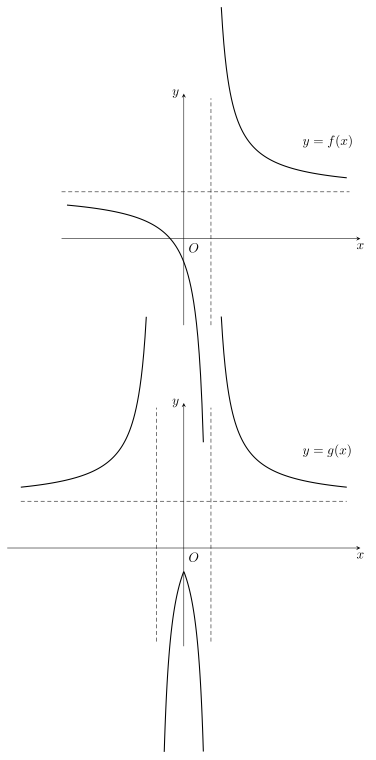
The graph of is shown. (Accessible description: vertical asymptote , horizontal asymptote ; for the graph is above and decreases toward it; for it lies below and approaches the asymptotes.)
The graph of was transformed to get the graph of as shown. (Accessible description: is even about the -axis, with vertical asymptotes , and for it matches the right-hand branch of reflected to the left.)
What transformation was applied?
How to recognise this question
Question type: graph transformations
- The command and notation point to graph transformations.
- The requested response is a multiple choice.
How to handle it: track how each transformation moves key points, asymptotes and intercepts of the base graph.
Watch out: Do not select a formula until its domain, interval, sign and units match the question.
Step-by-step answer
- The transformed graph is symmetric about the -axis: the right-hand branch of is copied to the left of .
- Replacing by leaves the graph unchanged for and reflects the graph across the -axis for . That is exactly .
- Option C only reflects through the -axis (swaps left and right, does not create even symmetry from an asymmetric ).
- Option B (square root) and option D (reciprocal) change heights and asymptotes, not merely mirror the positive- branch.
- Answer: A. (NESA multiple-choice key: A.)
Common mistake: choosing a familiar formula before checking that its conditions, signs, interval and units match this question.
The paper records 1 total mark for this group. Where the official marking guide provides useful partial-credit criteria, those criteria are stated in the steps above.
Try your hand at it again by answering these questions
Question 1
Starting from a non-even graph defined for with a vertical asymptote at , which transformation produces an even graph with asymptotes at ?
Question 2
If has a single vertical asymptote at (and is not even), which of the following produces a graph with a single asymptote at ?
Question 3
For , which statement about is true?