2022 HSC Mathematics Extension 1
Question 10:
Differential equation
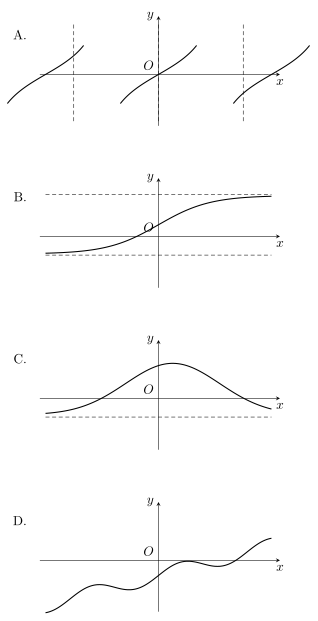
Which of the following could be the graph of a solution to the differential equation ?
How to recognise this question
Question type: differential equations
- The command and notation point to differential equations.
- The requested response is a multiple choice.
How to handle it: separate or integrate the differential equation, include the constant, then use the initial condition.
Watch out: Do not select a formula until its domain, interval, sign and units match the question.
Step-by-step answer
- Note that for all real , with equality precisely when , i.e. .
- Therefore every solution is non-decreasing: the graph can never have a negative slope.
- Option A includes decreasing pieces; option C has a local maximum — both impossible.
- Option D may look non-decreasing but does not respect the equilibrium levels where slope must be exactly zero when hits ; typical incorrect sketches cross or ignore those lines.
- Option B is non-decreasing and approaches horizontal asymptotes consistent with the zero-slope levels of the autonomous equation.
- Answer: B. (NESA multiple-choice key: B.)
Common mistake: choosing a familiar formula before checking that its conditions, signs, interval and units match this question.
The paper records 1 total mark for this group. Where the official marking guide provides useful partial-credit criteria, those criteria are stated in the steps above.
Try your hand at it again by answering these questions
Question 1
For , which property must every solution graph have?
Question 2
Solutions of can have horizontal asymptotes at
Question 3
A proposed solution graph of falls from to as increases. This is