2021 HSC Mathematics Extension 1
Question 9:
Inverse trigonometric functions
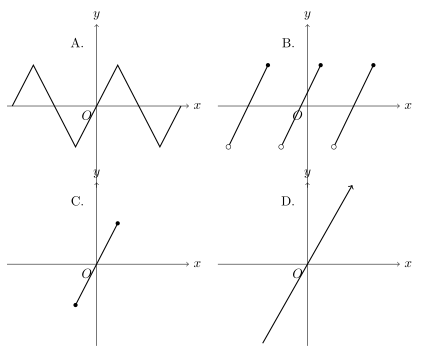
Which graph represents the function ?
(Four sketched graphs A–D on with range involving are supplied in the paper.)
How to recognise this question
Question type: inverse trigonometric functions
- The command and notation point to inverse trigonometric functions.
- The requested response is a multiple choice.
How to handle it: use the restricted domain and range that make the inverse function single-valued.
Watch out: Do not select a formula until its domain, interval, sign and units match the question.
Step-by-step answer
- The range of is , so the graph never leaves those horizontal bounds.
- On , (identity on the principal interval).
- Outside that interval, is not one-to-one, so the composition folds back: the graph is the classic triangular (sawtooth) wave that reflects into .
- Option A is that triangular wave. A straight line (B) is only valid on the principal interval. C confuses range with that of . D lacks the piecewise linear folds.
- Answer: A. (NESA multiple-choice key: A.)
Common mistake: choosing a familiar formula before checking that its conditions, signs, interval and units match this question.
The paper records 1 total mark for this group. Where the official marking guide provides useful partial-credit criteria, those criteria are stated in the steps above.
Try your hand at it again by answering these questions
Question 1
What is ?
Question 2
What is ?
Question 3
On which largest closed interval about is for all in the interval?