2021 HSC Mathematics Extension 1
Question 14(c):
Vectors
(i) For a vector , show that .
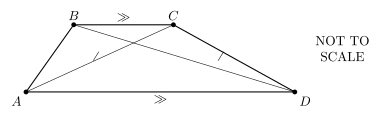
(ii) In the trapezium , is parallel to and .
Let , and , where .
Using part (i), or otherwise, show that .
How to recognise this question
Question type: vectors
- The command and notation point to vectors.
- The word “hence” means the later part is intended to reuse the earlier result.
How to handle it: write the vector relationship component by component, then use a dot product, magnitude or scalar multiple as required.
Watch out: Do not restart the second part with unrelated numbers or discard the result proved in the first part.
Step-by-step answer
- (i) If , then .
- Alternatively: .
- NESA (i): 1 mark.
- (ii) Diagonals: and .
- Equal lengths equal squared lengths: .
- Expand: .
- Simplify: .
- .
- Since , : .
- Rearrange: .
- NESA (ii): 3 marks; 2 for equating squared diagonal norms in terms of ; 1 for expressing a diagonal in terms of .
Common mistake: choosing a familiar formula before checking that its conditions, signs, interval and units match this question.
The paper records 4 total marks for this group. Where the official marking guide provides useful partial-credit criteria, those criteria are stated in the steps above.
Try your hand at it again by answering these questions
Question 1
(i) For a vector , show that .
(ii) In the trapezium , is parallel to and . Let , and , where . Using part (i), or otherwise, show that . Hence deduce that if , then .
Question 2
(i) For a vector , show that .
(ii) In the trapezium , and . Let , and with . Using part (i), show that .
Question 3
(i) For a vector , show that .
(ii) In trapezium , is parallel to and . Let , and , where . Using part (i), or otherwise, show that .