2020 HSC Mathematics Extension 1
Question 13(b):
Volume of revolution
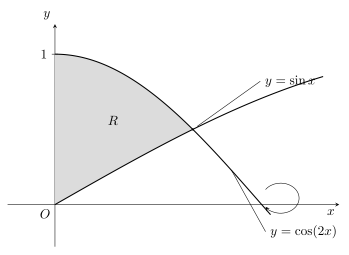
The region is bounded by the -axis, the graph of and the graph of , as shown in the diagram.
Accessible description: in the first quadrant near the origin, starts at and decreases; starts at and increases; they meet at the first positive intersection; is the region from to that intersection between the upper curve and the lower curve .
Find the volume of the solid of revolution formed when the region is rotated about the -axis.
How to recognise this question
Question type: volumes of revolution
- The command and notation point to volumes of revolution.
- The requested response is a worked solution.
How to handle it: identify the radius and use the disk or washer formula with the correct variable and bounds.
Watch out: Do not select a formula until its domain, interval, sign and units match the question.
Step-by-step answer
- Intersection: .
- (discard for the first-quadrant region).
- So . Volume: .
- Use and .
- Then .
- At : , , so .
- NESA: 4 marks complete; partial for intersection and washer setup / double-angle work.
Common mistake: choosing a familiar formula before checking that its conditions, signs, interval and units match this question.
The paper records 4 total marks for this group. Where the official marking guide provides useful partial-credit criteria, those criteria are stated in the steps above.
Try your hand at it again by answering these questions
Question 1
The region between and from to their first intersection is rotated about the -axis. Find the volume.
Question 2
Rotate about the -axis the region between and from to . Find the volume.
Question 3
Find the volume when the region between and from to is rotated about the -axis.